

Zero percent said very confident
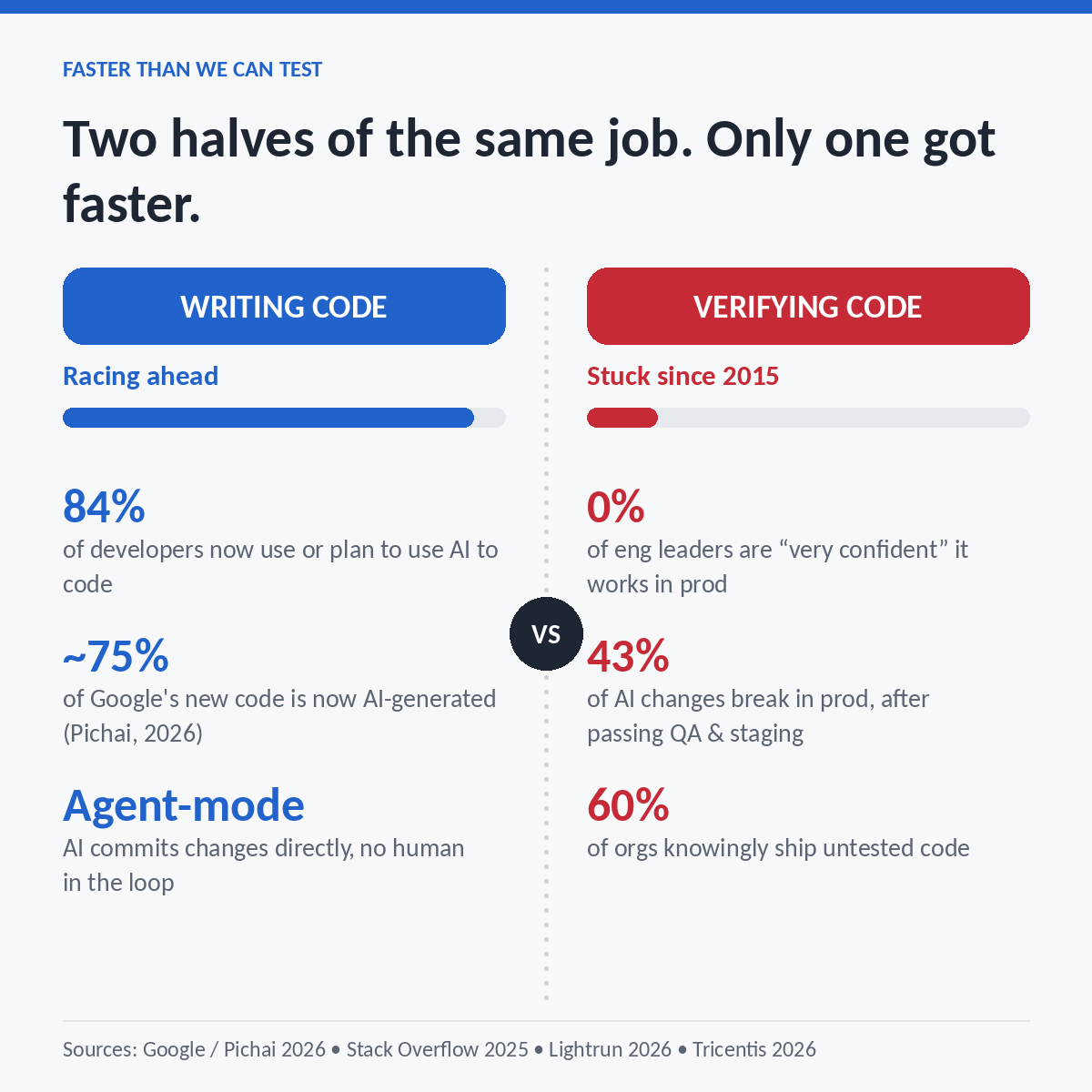
A 2026 survey asked engineering leaders how confident they were that AI-generated code would work in production. Zero percent said they were "very confident." Not a small number. None.
The same report found that 43% of AI-written changes still needed debugging in production after they had passed QA and staging. The tests were green, the change shipped, and it broke anyway.
That should give us pause. We have become very good at generating code, and no better at knowing whether it works. This is the story of AI in engineering right now: we made one half of the job ten times faster and barely changed the other half. Writing code is faster than it has ever been. Verifying that it does what we meant relies on the same reviews and the same "looks right, ship it" that we used in 2015.
Teams know this. In Stack Overflow's most recent data, more developers distrust AI output (46%) than trust it (33%). They ship it anyway, because it is fast and the calendar does not wait. A 2026 quality report found that 60% of organizations now knowingly ship untested code, and they do it on purpose, because the volume of AI-written code is too large to test the old way.
Then came April. A coding agent at a startup called PocketOS ran into a problem in staging, took an API token with far too much reach, and deleted the entire production database and every backup in nine seconds. The code it wrote was fine. Nobody had built the guardrail that would have stopped it before it ran.
That is the gap. The real question is how quickly you can trust what the AI just wrote, and the smaller your team, the less stands between a confident agent and production.
We spent three years making the writing faster. In 2026 the bill comes due on the verifying.
So, honestly: has your ability to trust a change kept pace with how quickly you now ship it? Or is that gap widening for you as well?
The data behind this post
- Lightrun's 2026 State of AI-Powered Engineering Report: 0% of engineering leaders "very confident" AI code works in production, and 43% of AI changes still break in production after passing QA and staging.: venturebeat.com
- Tricentis 2026 Quality Transformation Report: 60% of organizations knowingly ship untested code.: tricentis.com
- Stack Overflow 2025 Developer Survey: 84% of developers use or plan to use AI, and more distrust its output (46%) than trust it (33%).: survey.stackoverflow.co
- Google's CEO Sundar Pichai, April 2026: about 75% of Google's new code is AI-generated (Semafor, 24 April 2026).: semafor.com
- The PocketOS incident, April 2026: an AI coding agent wiped the production database and all backups in nine seconds.: livescience.com